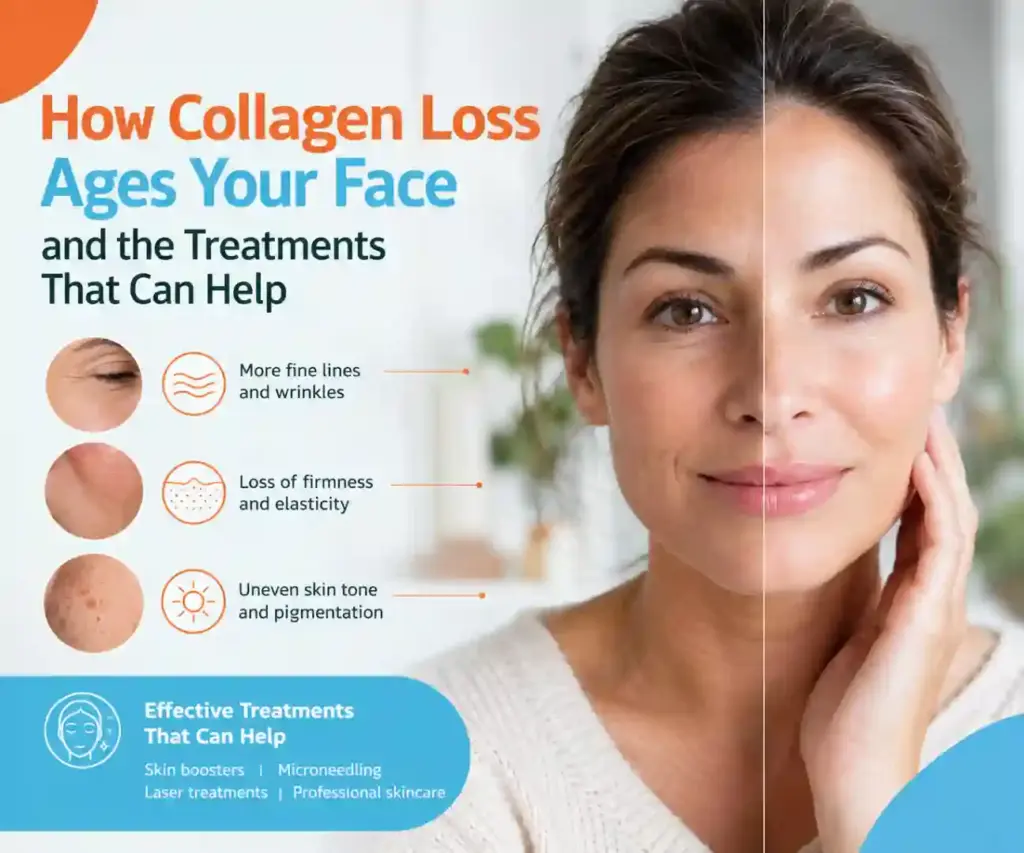
As we get older, changes in the face are not simply about developing a few more lines. The skin gradually loses some of the structural support that helps it look firm, smooth and resilient. Collagen plays an important part in that process.
Collagen is a protein found throughout the body and is particularly important within the dermis, the deeper layer of the skin. As we age, collagen becomes less organised and more fragmented, while the overall structure of the dermal matrix changes. These changes contribute to reduced firmness, elasticity and the development of visible signs of ageing. [1][2]
But collagen loss is only one part of facial ageing. Sun exposure, genetics, hormonal changes, lifestyle and natural changes in facial volume and bone structure can all influence how someone’s face changes over time.
So, what can actually be done about it?
What happens to collagen as you age?
Your skin constantly renews and repairs itself. Fibroblasts within the dermis produce collagen and other components that help maintain the skin’s structure.
As we get older, the skin gradually changes. Collagen production naturally declines, and changes within the skin’s supportive structure can affect how firm and resilient it feels. [1]
Over time, these changes may contribute to:
- Less firm or elastic-looking skin
- Fine lines becoming more noticeable
- A change in skin texture
- Crepey-looking skin in some areas
- Reduced definition around the jawline
- Increased skin laxity around the face and neck
Sun exposure can also accelerate visible skin ageing. This is one reason protecting your skin from ultraviolet radiation remains important alongside any cosmetic treatment. Also Read: RF Microneedling for Wrinkles, Fine Lines and Skin Laxity: What to Know
Importantly, not every change in facial appearance is caused by collagen loss. Skin laxity, pigmentation, facial volume changes and deeper structural changes may require very different approaches.
Why can your face look less firm with age?
Think of collagen as part of the skin’s supporting framework.
When that framework changes, the skin may gradually become less resilient. The result isn’t necessarily dramatic at first. You might simply notice that your cheeks don’t feel as firm, your jawline looks less defined or fine lines are becoming more visible.
This is why someone in their 30s, 40s, 50s or beyond may start considering treatments designed to improve skin firmness.
However, cosmetic treatment should not be about trying to stop normal ageing. A more realistic goal is to improve particular concerns while keeping expectations appropriate to the individual’s skin.
Can collagen loss be reversed?
This is where it is important to be realistic.
Aesthetic treatments cannot turn back biological ageing or recreate exactly the skin you had years ago. Treatments such as RF microneedling are intended to improve aspects of skin appearance, including firmness and texture. The effects develop gradually rather than immediately, and the level of improvement varies between individuals.
The results can vary from person to person, depending on your skin, the area being treated, the level of skin laxity and how your skin responds to the treatment. Check Out This Also: Why Your Skin Loses Firmness After 40 (And What You Can Do About It)
That is why a consultation is more useful than choosing a treatment simply because it is described as a “collagen booster”.
Collagen Lift Therapy: how does it work?
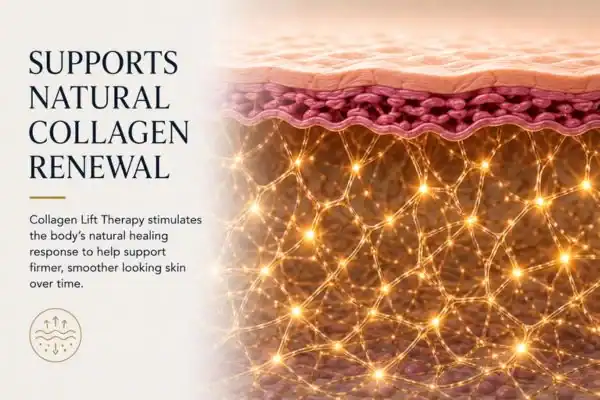
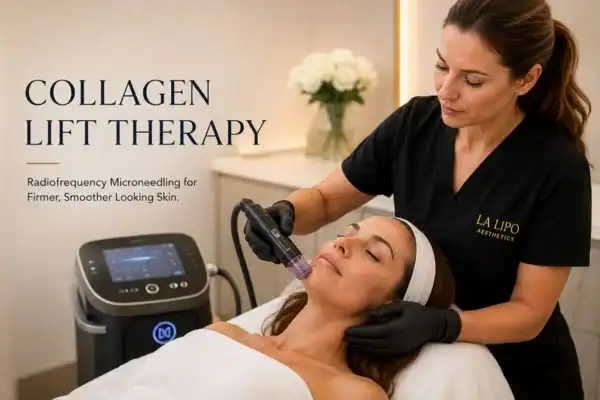
At LA LIPO Oldham, Collagen Lift Therapy refers to a radiofrequency microneedling treatment. The treatment combines very fine needles with controlled radiofrequency energy.
The treatment combines tiny, controlled needle punctures with radiofrequency energy. It is intended to create controlled treatment effects within the skin, with the aim of improving the appearance of skin texture and firmness.
LA LIPO Oldham describes the treatment as being used for concerns including skin laxity, fine lines, uneven texture, acne scarring and areas such as the face, neck and jawline.
The important point is that this is not an instant treatment. Any visible improvement develops progressively rather than appearing immediately, and results vary between individuals.
What can RF microneedling help with?
Radiofrequency microneedling may be considered where the main concern involves skin quality or mild-to-moderate laxity.
Depending on suitability, treatment may be discussed for:
- Fine lines and wrinkles
- Mild skin laxity
- Uneven skin texture
- The appearance of enlarged pores
- Acne scarring
- Crepey-looking skin
- Certain areas of the neck or jawline
However, it is not appropriate to assume that RF microneedling will solve every form of facial ageing.
For example, significant excess skin may require a different discussion, while loss of facial volume is not simply a collagen problem.
What is the treatment actually like?
Before treatment, the skin should be assessed to determine whether the procedure is appropriate and which areas may reasonably be treated.
LA LIPO’s current treatment information states that topical numbing cream is used and that patients may experience sensations of heat and pressure during treatment.
Afterwards, temporary redness, swelling, sensitivity or pinpoint marks can occur. Everyone’s recovery differs and depends on the area treated and how their skin responds.
This is one reason it is better not to schedule treatment immediately before an important event without allowing suitable recovery time.
When will you see results?
Visible changes following RF microneedling develop gradually rather than immediately.
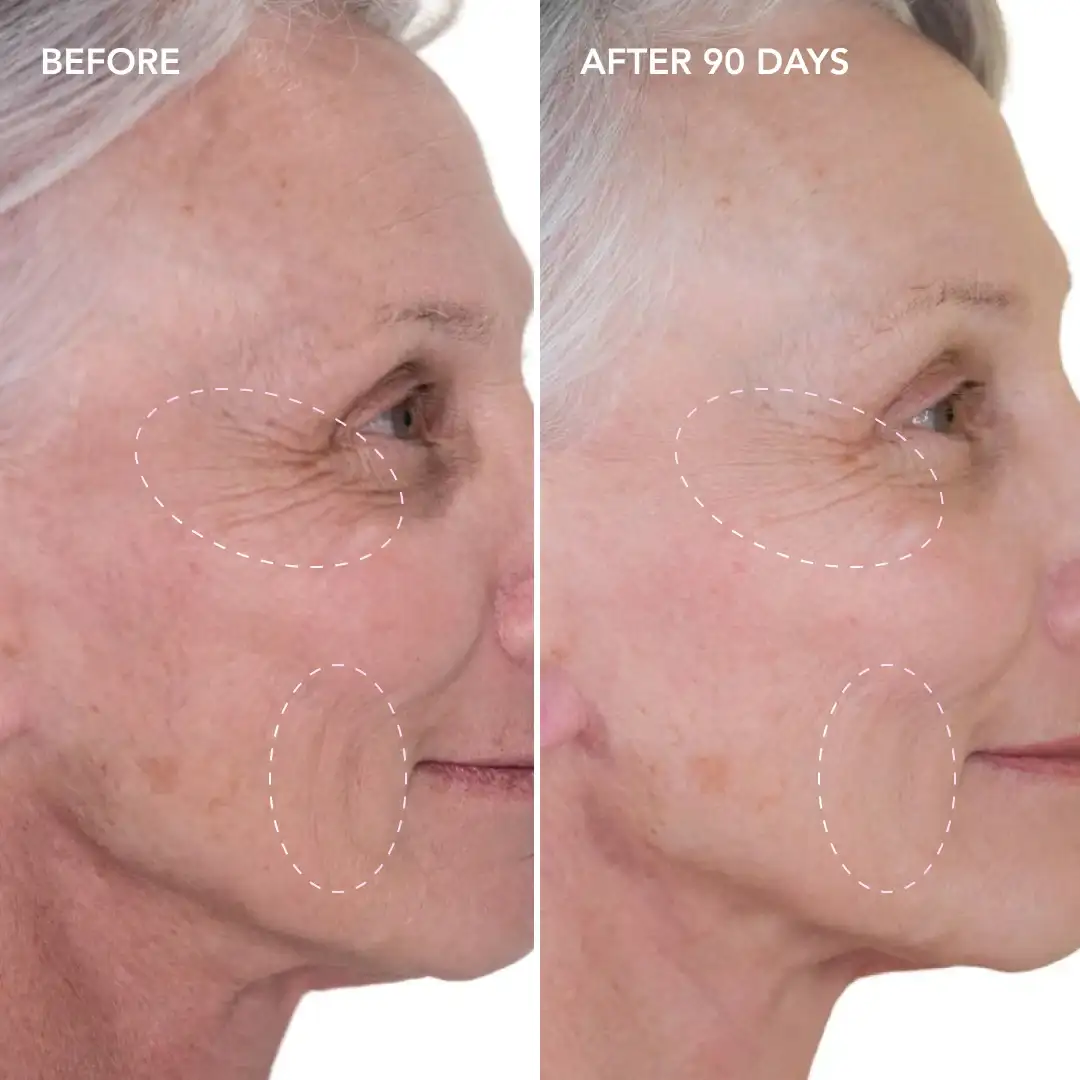
You should not expect the final appearance immediately after RF microneedling. Some people may notice changes in the weeks following treatment, while further improvement may develop over subsequent weeks. The timing and extent of any visible change vary between individuals.
Individual results can differ considerably, so these timeframes should be treated as guidance rather than a promise.
A course of treatments may be recommended rather than a single session, depending on the individual’s skin, treatment area and goals. The number of treatments and the timing between them can vary, so your treatment plan should be discussed and agreed following an individual assessment. Also see our client before-and-after results here.
Who may not be suitable?
RF microneedling is not automatically suitable for everyone.
Treatment may need to be postponed or avoided depending on factors such as:
- Pregnancy or breastfeeding
- Active skin infection
- Certain implanted electronic devices
- Problems with wound healing
- Certain skin conditions or medications
LA LIPO specifically identifies pregnancy or breastfeeding, active skin infections, certain implanted electronic devices and impaired wound healing as reasons treatment may not be suitable.
This list should not be treated as exhaustive. Your practitioner should take your medical history, skin condition and individual circumstances into account before treatment.
If a new, changing, bleeding or otherwise unusual skin lesion is causing concern, cosmetic treatment should not replace appropriate medical assessment.
Are there alternatives to collagen-stimulating treatments?
Yes. The right approach depends on what is actually causing the concern.
For some people, improving skincare and sun protection may be the most appropriate starting point. Others may discuss treatments such as HIFU, RF microneedling or combinations of treatments.
LA LIPO also offers HIFU and provides information about combining HIFU with RF microneedling. Whether combining treatments is appropriate depends on the individual’s concerns, skin and assessment.
More invasive procedures may also be relevant when there is significant excess skin or structural change. A non-surgical treatment should not be presented as equivalent to surgery.
What should you ask before choosing treatment?
A good consultation should be about more than simply being told which treatment to book.
Consider asking:
- What is actually causing my concern — skin laxity, texture, volume loss or something else?
- What improvement is realistic for my skin?
- How many treatments might I need?
- What downtime should I plan for?
- What side effects or complications should I know about?
- Are there reasons this treatment may not be suitable for me?
- What alternatives should I consider?
- What happens if the treatment does not produce the improvement I hoped for?
These questions can help you make a decision based on suitability rather than marketing claims.
Frequently Asked Questions
Q: Does collagen loss cause wrinkles?
Collagen changes contribute to the structural changes associated with skin ageing, including reduced firmness and the appearance of wrinkles. However, wrinkles have multiple causes, including changes in elastin, repeated facial movement and cumulative sun exposure. [1][2]
Q: Can RF microneedling replace lost collagen?
No. RF microneedling does not simply replace missing collagen. It is intended to create controlled treatment effects within the skin, with the aim of improving aspects of skin appearance such as texture and firmness.
Q: Is Collagen Lift Therapy suitable for mature skin?
Age alone does not determine suitability. Skin condition, medical history, degree of laxity, treatment goals and expectations all matter. A consultation is needed before deciding whether treatment is appropriate.
Q: How long does RF microneedling take to work?
Results are gradual rather than immediate. Some people may begin to notice changes in the weeks after treatment, with further improvements developing gradually as their skin responds. Everyone responds differently, so the results and how quickly they develop can vary from person to person.
Q: Does RF microneedling hurt?
People experience treatment differently. LA LIPO states that topical numbing cream is used and that patients may experience heat and pressure during treatment.
Q: Is one treatment enough?
Not necessarily. Some people may be advised to have a course of treatments depending on their skin, treatment area and goals. The number and timing of treatments should be determined following an individual assessment.
Q: Can collagen supplements prevent facial ageing?
There is currently limited evidence that collagen supplements can prevent normal facial ageing. Research into their effects on skin appearance is still developing, and results from studies are not consistent. [3]
Q: Should I have cosmetic treatment for a changing skin lesion?
No. A new, changing, bleeding or otherwise suspicious lesion should be assessed medically rather than treated purely for cosmetic reasons.
REFERENCES & FURTHER READING
[1] Taihao Quan & Gary J. Fisher — “Role of Age-Associated Alterations of the Dermal Extracellular Matrix Microenvironment in Human Skin Ageing: A Mini-Review” — Gerontology, 2015.
Direct source: PubMed record
Supports: The explanation of age-related collagen fragmentation, changes to the dermal structure and declining skin function.
[2] Uitto J. et al. — “Skin ageing” — Clinical and Experimental Dermatology, 2007.
Direct source: PubMed record
Supports: The discussion of collagen atrophy, reduced elasticity and the multifactorial nature of skin ageing.
[3] Seung-Kwon Myung et al. — “Effects of Collagen Supplements on Skin Ageing:
Direct source: PubMed record
Supports: The cautious discussion of collagen supplements and the limitations of the current evidence.
[4] ASA/CAP — “Guidance on the marketing of surgical and non-surgical cosmetic procedures”, 2023.
Direct source: ASA/CAP guidance
Supports: The need for responsible cosmetic-treatment claims, evidence for objective claims and avoidance of exaggerated or unrealistic results.
[5] ASA/CAP — “Beauty and Cosmetics: General”, updated 2026.
Direct source: ASA/CAP beauty and cosmetics guidance
Supports: The requirement for evidence behind efficacy claims and the need to avoid exaggerating cosmetic effects.
For Further Information, Please Call Us ON 03300 100 238